THE SECRET IS OUT


Every once in a while we come across a company that promises to deliver on high expectations in the web development arena. The company that accomplishes this, Memetrics, does not create websites …. it tears them apart.

The focus of this company is to test a host of variable assets that, when combined, make up a website. That’s keeping it very, very simple. Multivariate testing and analysis is the name of the game.

As marketers are faced with the mission critical need to stretch their ROI, Memetrics can step in and tell you what’s working, what’s not, and how to fix it. Mulitvariate testing can successfully boosted conversion rates by as much as 600%. Yes ….. 600%!!

Memetrics performs this task in short order as it leverages the dynamics of the web to reduce traditional (and limited) testing scenarios from months to weeks.

The company also opened itself to work across multiple channels …. Direct mail, interactive TV and call centers

The “brainiac” Co-CEOs that run this company are led by Hikaru Phillips and Matt Symons. Hikaru trained as an evolutionary biologist. Hikaru's approach to "adaptive marketing" has helped leading marketers leverage hypothesis testing, experimental design and optimization based on Nobel Prize winning Choice Modeling theory. Matt, formerly an attorney for one of Australia's largest law firms has been designing and delivering experimentation roadmaps for Memetrics' global clients since joining the company in 1999.

Now you know one of my secret weapons. Defend yourselves!

You can reach Memetrics though their website at
www.memetrics.com, or call Chad Miller at (815) 389-0530.


CELL CULTURES


Riding a bus up Third Avenue in New York City last week I encountered a young adult in her early 20’s chatting up a friend on her cell phone. Most passengers on the crowded bus were visibly annoyed as she turned up the volume of her voice. Several stops and a few minutes later her fellow passengers knew what she was doing for the evening, where she was going and what she was having for dinner. Enough! I excused myself for “interrupting” her with “it’s a TELEPHONE not a MICROPHONE!” Applause erupted as she whispered into the phone.


The cell phone is now so embedded in our culture that it is taken for granted, often abusing an expected etiquette that comes with ownership. Cell phones are morphing into appendages that provide gaming, photography, email, texting, scanning, entertainment, data, e-commerce and more. We put up with this marvel of technological progress because we demand it …. Culture drives technology and easily abuses it.


Cultural differences between countries become strikingly obvious as we observe “cell phone culture” around the world.


In Japan, for example, mobile phone culture, or "keitai culture" talking on a mobile phone while riding a bus or train is frowned upon and messages asking passengers not to make calls and to switch their phones to silent mode ("public mode" or "manners mode" in Japanese) are played frequently. As a result, texting is huge in Japan, overshadowing the U.S. in volume. It is so prevalent that phone manufacturers have abandoned the common flip-phone, for a more open model that makes texting easier and faster…. culture driving innovation.

In the U.S. music often defines “who we are”. Music projects our personal taste. Not in China, where music is not as important as fashion. In China, fashion defines who you are resulting in a dizzying array of phone skins and colors.

Laws also affect cultural change as it has in Saudi Arabia where conversation between the sexes is taboo. As a result, texting has taken root.

In Sweden, punk subcultures like big clunky phones, as an expression of who they perceive themselves to be in relation to world culture and in Belgium, text messages are far more common than voice calls. A lot of text messages are “teasers” that aren't intended to provoke a response.

The world has become a petri dish of sorts for examining the cell phone culture that surrounds us.


NOW YOU SEE THEM, NOW YOU DON'T- INVISIBLE CUSTOMERS


Got an e-commerce website? Got a handle on your visitors?
There are many millions of consumers shopping on the web, abandoning the crowded isles and store trips for the convenience of the web. They are finding a range of products and services they would otherwise go searching for in the physical world.

They are also missing something….the ability to interact with other customers and sales staff to help them find the products they are looking for. The online world loses the crowd that can interact in a fluid, natural manner where like-minded consumers trade information.

Most consumers do not leave feedback or reviews. And many do not make purchases, moving on to other sites. They are invisible to the site owner, taking away with them valuable information, opinions and suggestions which, if captured, could yield a more compelling shopping experience and higher sales.

Behavior analytics, demographic segmentation and rule based targeting can only go so far. New software, focusing on input based on social science, or the collective influence of a consumer group, can tap into the invisible customer across multiple dimensions, allowing for collective product targeting. The concept can lift conversion rates by at least 20%.

The use of surveys and user rankings can serve to introduce the necessary collective bias into segmentation strategies to hyper-target product recommendations.


ROAD KILL -- INTERNET FASHION

If we took the time to think....really THINK about ways we can spend valuable time dreaming up useless inventions, this is what we are likely to wind up with.

An internet unmbrella that allows you to take photos, post them to the web and browse them as downloads as you go "singing in the rain"!

Try this in New York City on a rainy day while ignoring traffic and you'll be road kill really, really fast!

Watch the video . . . .


A MARRIAGE OF CONVENIENCE

Google’s announcement to purchase DoubleClick helps the company in more ways than one. Google has not had an easy go of it with agencies and advertisers in the display arena. Yahoo! leads in that game by a wide margin.

One of the problems Google had to deal with was their inability to work with third party adservers such as DoubleClick and Mediaplex (ValueClick) to provide independent auditing of their traffic and integrated reporting. Now they will be the industry’s server of choice, making that problem disappear.

Google also stands to benefit from bid auction models DoubleClick has been developing as well as its pending discussions to work with Donovan Data Systems to develop integrated media maintenance systems integrated with ad agency financial systems.

At an staggering purchase price of $3.1 Billion, this will put into play speculation about Aquantive (AQNT), ValueClick (VCLK) and 24/7 (TFSM) as the next in line for buyouts by the likes of Microsoft and Yahoo!.

As a company that has had much difficulty playing in the agency arena, Google, still needs to understand the agency business and must play by agency and advertiser rules if it is to break into the general marketplace beyond search. They have all the right pieces for the puzzle …. they have not yet figured out how to make them fit.

ONE "RINGY DINGY"

Millions of people have more than one phone number these days — home, work, cellular, hotel room, vacation home, yacht — and with great complexity comes great hassle. You have to check multiple answering machines. You miss calls when people try to reach you on your cell when you’re at home (or the other way around). You send around e-mail messages at work that say, “On Thursday from 5 to 8:30, I’ll be on my cell; for the rest of the weekend, call me at home.”

And when you switch your job, cellphone carrier or home city, you have to notify everyone you know that you have new phone numbers.


A new service called GrandCentral, now in its final weeks of public beta testing, solves all of these problems. It’s a rather brilliant melding of cellphone and the Internet.
Its motto, “One number for life,” pretty much says it all. At
GrandCentral.com, you choose a new, single, unified phone number. You hand it out to everyone you know, instructing them to delete all your old numbers from their Rolodexes.

From now on, whenever somebody dials your new number, all of your phones ring simultaneously.
No longer will anyone have to track you down by dialing each of your numbers in turn. No longer does it matter if you’re home, at work or on the road. Your new GrandCentral phone number will find you.
As a bonus, all messages now land in a single voice mail box. You can listen to them in any of three ways. First, you can dial in from any phone (a text message arrives on your cellphone to let you know when you have voice mail). If you call in from your cellphone, you don’t even have to enter your password first.

You can also play your messages on the Web, at GrandCentral.com, and download them as audio files to preserve for posterity. You can even ask to be notified by e-mail; a link in the e-mail message takes you online to play the voice mail.

All of this, incredibly, is free if you have only two phone numbers to consolidate. A premium plan, at $15 a month, offers more of everything.

There are only two substantial downsides to becoming involved with GrandCentral. First, GrandCentral offers you a choice of about 20 numbers, but it doesn’t yet offer phone numbers in every area code, so your next-door neighbor may wind up having to dial an out-of-town number to reach you. In 14 central states, in fact, GrandCentral offers no numbers at all. (You can see what’s available at GrandCentral.com.)

Otherwise, this unification of all your phones and answering machines truly makes life less complicated.

GrandCentral offers a huge list of additional features that aren’t so simple. If you’re not careful, GrandCentral can turn into a full-blown hobby. For example:

CALLER NAMING Every GrandCentral caller is announced by name when you answer the phone.
How does it know the name? Sometimes Caller ID supplies it. GrandCentral also knows every name in your online address book, which can import your contacts from
Yahoo, Gmail or your e-mail program.
Callers not in these categories are asked to state their names the first time they call. On subsequent calls, GrandCentral recognizes them.

LISTEN IN For what may be the first time in cellphone history, you can listen to a message someone is leaving, just as you can on a home answering machine.
Your phone rings and displays the usual Caller ID information. You answer it. But before you can even say “Hello,” GrandCentral’s recording lady tells you the caller’s name, and then offers four ways to handle the call: “Press 1 to accept, 2 to send to voice mail, 3 to listen in on voice mail, or 4 to accept and record the call.” Your callers have no clue that all this is going on; they hear only the usual ringing sound.

If you press 3, the call goes directly to voice mail — but you get to listen in. If you feel that the caller deserves your immediate attention, you can press * to pick up the call.
This subtle feature can save you time, cellular minutes and, in certain cases of conflict-avoidance, emotional distress.

RECORD THE CALL Hitting 4 during a call begins recording it; GrandCentral then treats the recording as a voice mail message. Here again, you can immortalize the historic calls of your life, or just create a replayable record of driving directions. GrandCentral notes that laws in some states require both parties to know that a call is being recorded.

RINGBACK MUSIC This bizarre little feature is evidently popular with young cellphone users in Europe, but is still rare in the United States. It lets you replace the ringing sounds the caller hears while waiting for you to answer with music—in GrandCentral’s case, any MP3 file of your choice.

CUSTOMIZE GREETINGS Control freaks, rejoice. You can actually record a different voice mail greeting for each person in your address book: “Hi, sugarcheeks” for your sweetheart; “Can’t take your call right now, I’m out looking for a better job” for your mother.

You can also specify, on a per person basis, which of your phones ring, which ringback music plays and whether the call goes directly to voice mail.

Finally, you can tell GrandCentral to answer certain people’s calls with the classic three-tone “The number you have dialed is no longer in service” message. Telestalkers, bill collectors and ex-lovers come to mind. Never has technology been so deliciously evil.

SWITCH LINES Anytime during a call, you can press the * key to make all of your phones ring again, so that you can pick up on a different phone in midconversation, unbeknownst to the person on the other end. For example, if you’re heading out the door, you can switch a landline call to your cellphone — or as you arrive home, a cell call to a landline, in order to save airtime minutes.

WEB BUTTONS You can install a “call me” button on your Web site — a great, free way to field calls from your eBay, MySpace or dating-service Web page without actually posting your phone number.
All of this works smoothly and quickly, and the Web site does a noble job of organizing that dizzying number of functions. And all of these features are free, even those that would be expensive or unavailable from your phone company.

Still, you may be forgiven for feeling that GrandCentral’s central idea — a virtual phone number that’s not associated with a particular telephone — is too much of a radical brain-slamming change. You may also feel that the last thing your life needs is more phone calls reaching you successfully.

But anyone who spends some time contemplating GrandCentral’s possibilities will soon see the bigger picture: this service removes your location as a consideration in phone calling, much the same way that the TiVo makes a TV show’s broadcast time unimportant. In other words, GrandCentral has rewritten the rules in the game of telephone.

This post was annotated and reprinted from The NY Times Technology Section (3/15/2007).


YOU DON'T HAVE MAIL!
Today’s protocol for IP addresses allows for only 4.3 billion or 2/32 addresses. It is estimated that by 2012, we will run out of addresses under the IPv4 protocol. That’s not enough to go around and a new protocol, IPv6, will generate 5×10/28 addresses for each of the roughly 6.5 billion people alive today. IPv6 is coming whether you and your organization have adequately planned for it or not. Companies and government agencies should be prepared for this inevitability.

Take a Net-Centric View – Understand How IPv6 affects Your Organization. Action is the most important factor. You must understand what IPv6 will mean to your operation. What are its implications at a high level? Viewing your operation in a network centric world means that before you do anything your IT team must understand how IPv6 will impact your operation.

Identify What Needs to Change. Identify current software and services that are running on your network and understand the gap analysis for v6 transition. Work with your vendors and provide documentation of your plans to your vendor community to create a collaborative plan for IPv6. Understand the timelines for “IPv6 capable”. Establish upgrade strategies, and map out alternative methods to work around varying vendor IPv6 readiness.

IPv6 value is about connecting to your goods and service, products and customers wherever they exist. Establish the network connectivity roadmap and work with your vendors to collaborate on specifications for connectivity. This will advance you toward the competitive advantage of “everything connected.”

Don’t Be in Denial. Even if your organization is not thinking about it, you must begin to address IPv6 in some ways. Vista is here and Windows Server “Longhorn” is coming -- and they are v6 by default. Today you can buy v6 capable phones over the counter that will wirelessly try to connect v4 or v6 and then start attempting to tunnel to the v6 Internet. The drivers are all around us. Ten years ago you started using email and today network penetration is still accelerating. IPv6 is more prevalent than you realize.

The preceding was excerpted an annotated from Command Information, reachable at: http://www.commandinformation.com/ipv6/index.php

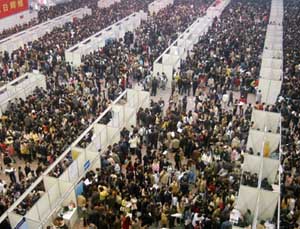
Photo: Job Fair in China

PEOPLE WHO NEED PEOPLE

As the market for goods and services in China explodes and its economy rides on job growth, it faces an oversupply of intellectual capital as university graduates swell in the face of few jobs. This year, as reported by China Daily, it is expected that 5 million graduates will be vying for half as many jobs.

The imbalance has created a new growth business …. recruitment, growing at many multiples the GNP. Companies such as P&G, LG, and Microsoft have set up “Elite Clubs” in universities in an effort to reserve future employees.

In stark contrast to the available entry level market, mid-managers and senior executives are becoming scarcer, with a corresponding void in the ability for many firms to successfully drive vision with clarity.

In our own media world, the latter half of the scenario replays itself as we face a lack of seasoned professionals who have either moved into other areas or left the business entirely. Our industry’s response to the problem has been only to “beef up” recruitment when it should be coupled with investment in development and training of the currency we all depend upon …. our people.
TOUCHY-FEELY

It's, very simply, the future of computing.


Clik on the following link to view the video

http://www.ministryoftech.com/2007/01/18/perceptive-pixel-interactive-touch-ui/

For more information on the genesis of this project, go to:
http://www.fastcompany.com/subscr/112/open_features-canttouchthis.html

JUICY NEW TECHNOLOGY

The Universal Product Code (UPC) made its first commercial appearance on a 10-Pack of Wrigley's Juicy Fruit gum sold in Marsh's Supermarket in Troy, Ohio on June 26, 1974 for 67 cents. Much has changed.

The ubiquitous bar code is slowly evolving to provide much more than the simple management and tracking of inventory. Today, barcodes track rental cars, air traveler luggage, mail, library books and more. It has processed billions upon billions of items through the checkout counter and sped up the processing of returns.

As bar codes became popular and their convenience universally recognized, the market began to call for codes capable of storing more information.
Efforts to increase the amount of information stored by bar codes, however, caused problems. Enlarging the bar code area complicated reading operations, and increased printing costs.

As a result, a more sophisticated two-dimensional density matrix code (QR CODE), storing information in both vertical and horizontal directions, was developed by Denso Corp. to pack over 300 times the numeric data stored in conventional (UPC) barcodes…. in a minimal amount of space.

QR Codes will go far to break down barriers to mobile e-commerce as scanners are built into state-of-the-art mobile phone and communication devices. Beyond product labeling, these codes can be created to capture data “on the go” on ads, business cards, address books, maps and comparison price shopping. Amazon.com is experimenting with QR codes in Japan, generating affiliate mobile sales through scanner enabled mobile phones.

Applications are as boundless as a marketer’s imagination
.


UPC CODE vs. QR CODE